I took the day off from worrying about art today, and drove to Swansea to visit my very dear, long-time old friend Alun, who is facing some tough times health-wise. I hadn't seen him for a couple of months, so it was good to have time to catch up, and also to admire the completion of work on his lovely house in Mumbles, which has been exquisitely renovated and extended, complete with a room dedicated solely to being his library, another room for a study/office, and a wonderful open-plan sitting room/kitchen/dining room all opening onto the garden. He also has organised a labour-saving gas-fired wood burner, a very swish kitchen and bathroom, and fabulous sea views from almost every window. He is only a few minutes walk from the water's edge. The weather was lovely, so Swansea Bay was at its summer best. We had a nice stroll along to Mumbles for lunch, and then coffee at the legendary Verdi's ice cream parlour.
I had taken him a quilt, too, which I had made from a bundle of fabrics bought at the Festival of Quilts at the NEC two years ago, and made for him last year and intended for his 60th birthday, but somehow it wasn't quite finished then and the moment passed. But now it was the perfect gift, and he seemed genuinely pleased to have it - and best of all, it fits perfectly on his big squashy sofa.
So when he is in the thick of debilitating treatment in the next couple of months, I hope he can snuggle under or on this quilt while he's watching rubbish telly or reading co-op history, or whatever, and it will act like the rainbow quilts I made for my children when they were small - which came with the message that "no-one can be sad under a rainbow quilt" - so I hope Alun won't feel so bad under a star quilt either.
Wednesday, 16 May 2012
Tuesday, 15 May 2012
College, 15th May
This afternoon I decided to do a proper reflection and review of my project so far, because I feel as though I have been getting stuck, not making progress, flitting from one idea to another, and not getting on even with the essentials, e.g. updating my note/sketch/ideas book, or finishing my research folder. Luckily, most people were busy and so the main print room was almost empty and quiet, so I could settle down and read through everything, starting with my original Statement of Intent. It proved to be a very therapeutic process, as it reminded me of the strong ideas I had started out with, and allowed me to see (a) how much exploratory work I have done, which seems to me to be quite a lot, and quite wide-ranging; and (b) to see that I have been on a rather circuitous journey, but that I have now almost arrived at a place which makes sense for the final presentation of my project. I came away at the end of the day feeling a lot happier, and with a (long) list of things i now need to do to finish off the background.research/ideas work, and to complete the pieces for the final show.
There will be two pieces. One will be a properly made film of the paper shreds falling. I've booked a video camera and tripod for Monday, and will bring all the paper shreds into college and find a quiet place to do the filming here on Monday. That should leave plenty of time on Tuesday to edit the film, and it can go on the group 'show reel' which will be prepared and run continuously during the show.
Secondly I'm going to organise a big flat tray-shaped plinth, ideally about a metre square but it will probably have to be a bit smaller than that. It will have an upright 'wall' all round it, about 5 or 6 inches high. Inside I will line with black paper and/or paint it matt black. I will pile up all the shreds of paper inside the box. The idea will be to invite visitors to touch the paper, to pick it up and door it, run their hands through it, like sand in a sand-pit.
I may, if time allows, also make a small book to go alongside the paper box, to link the box and the film with the concept of deconstruction, throwing away, creating new.
I am trying to hang on to the principle of "less is more" but my piece is so conceptual I'm a bit worried that it may be too obscure. But it depends how well the film comes out...and/or whether the pieces in a big aback box work either. I might end up with just one or the other but not both. NO harm in having options, even at this late stage.....
There will be two pieces. One will be a properly made film of the paper shreds falling. I've booked a video camera and tripod for Monday, and will bring all the paper shreds into college and find a quiet place to do the filming here on Monday. That should leave plenty of time on Tuesday to edit the film, and it can go on the group 'show reel' which will be prepared and run continuously during the show.
Secondly I'm going to organise a big flat tray-shaped plinth, ideally about a metre square but it will probably have to be a bit smaller than that. It will have an upright 'wall' all round it, about 5 or 6 inches high. Inside I will line with black paper and/or paint it matt black. I will pile up all the shreds of paper inside the box. The idea will be to invite visitors to touch the paper, to pick it up and door it, run their hands through it, like sand in a sand-pit.
I may, if time allows, also make a small book to go alongside the paper box, to link the box and the film with the concept of deconstruction, throwing away, creating new.
I am trying to hang on to the principle of "less is more" but my piece is so conceptual I'm a bit worried that it may be too obscure. But it depends how well the film comes out...and/or whether the pieces in a big aback box work either. I might end up with just one or the other but not both. NO harm in having options, even at this late stage.....
Monday, 14 May 2012
College, 14th May
Saturday, 12 May 2012
Stroud Textiles
Today a tremendous visit to Stroud and Nailsworth to see some of the work on show in the Stroud International Textiles exhibition and in the accompanying textiles artists studios trail. Running at the same time is the SITE Stroud artists festival and arts trail. I went with friends Glen and Tony Eastman, and we tried to see as much as we could, but the trails extend way beyond Stroud and Nailsworth and there was a lot we couldn't manage in a single day's visit. However, the weather was fabulous, an especial treat after the relentless rain of the past few weeks, and the towns were in festive mood, probably more because of the sun than the art. We saw some wonderful work.
First off was the main exhibition, Select Pairings II, Conversations and Collaborations, at the Stroud Museum. Here the festival had paired up textile artists with other creatives, and invited them to work together to produce new pieces. The results were exciting and innovative, showing the strength and diversity of individual artists' work, and the sometimes surprising things which can happen when unusual couplings of talent are made. I liked all of it but the things which particularly caught my attention included the combined textile and ceramic work where Alice Kettle's stitch drawings on linen were complemented by Helen Felcey's understated porcelain vessels, so the whole thing looked like a table set for a meal. like this....
This image, and more, from Alice Kettle's website here.
In similar vein, I also liked the work by Sharon Blakey and Ismini Samanidou, who combined delicate fabric, printed with semi-legible text, alongside cast replicas of table cutlery, and the imprint of these into paper. The combination of object, stitch, line and texture was compelling but very simple, and referred, I think, to the memory and ritual stored up in shared meals, shared experiences across cultures.
One example is here...
The image is taken from Sharon Blakey's MMU website entry here, where there is more about her work.
Another very interesting pairing was that between textile artist Jane McKeating (website link here) and Jilly Morris (website link here) who works with enamel and drawing as well as stitch. They produced a series of curled forms, each quite small and embellished with bold drawn or stitched lines and wrapped threads. My photo doesn't do the work justice but gives a flavour of their collaboration.
First off was the main exhibition, Select Pairings II, Conversations and Collaborations, at the Stroud Museum. Here the festival had paired up textile artists with other creatives, and invited them to work together to produce new pieces. The results were exciting and innovative, showing the strength and diversity of individual artists' work, and the sometimes surprising things which can happen when unusual couplings of talent are made. I liked all of it but the things which particularly caught my attention included the combined textile and ceramic work where Alice Kettle's stitch drawings on linen were complemented by Helen Felcey's understated porcelain vessels, so the whole thing looked like a table set for a meal. like this....
This image, and more, from Alice Kettle's website here.
In similar vein, I also liked the work by Sharon Blakey and Ismini Samanidou, who combined delicate fabric, printed with semi-legible text, alongside cast replicas of table cutlery, and the imprint of these into paper. The combination of object, stitch, line and texture was compelling but very simple, and referred, I think, to the memory and ritual stored up in shared meals, shared experiences across cultures.
One example is here...
The image is taken from Sharon Blakey's MMU website entry here, where there is more about her work.
Another very interesting pairing was that between textile artist Jane McKeating (website link here) and Jilly Morris (website link here) who works with enamel and drawing as well as stitch. They produced a series of curled forms, each quite small and embellished with bold drawn or stitched lines and wrapped threads. My photo doesn't do the work justice but gives a flavour of their collaboration.
There was much to admire in the exhibition, more information on the SIT website here.
Then into Stroud to visit some of the open studios in the textile and arts trails. There were separate printed guide books for each, beautifully presented but lacking in decent maps, so we wandered about a bit, and managed to completely miss some of the out-of-town venues because the map was so poor, and/or because the signage on the road was unclear. That aside, the information about artists was good, and we found the main sites we wanted to see.
The Stroud Valley Arts (SVA) building in John Street was a treasure trove. I particularly liked the textile studio work, including particularly the felt by Anne Rogers, and the hand printed or hand-painted textiles by Jenny Bicalt.
I was fascinated by the work of Emily Joy (website here, from where the photo next was copied) who had built a kind of double ended printing machine out of two old-fashioned laundry mangles, one end could take and print type, the other end could print a kind of braille.
She had used this to print and over print on a continuous loop of paper, so that the text and the braille eventually almost obscured each other, and the meaning (or memory) was distorted and obliterated. I thought this had big resonances for the work I'm doing in relation to deconstructing and obliterating the text of my old working life. It also resonated with some of the work seen in the Lost in Lace show in Birmingham earlier this year.
Upstairs there were several other artists whose drawings and paintings were very striking, including Bill Jones (link here) whose indian ink drawings were very appealing, reminding me of John Piper's Welsh landscapes seen recently in Cardiff; and Zoe Heath (link here) whose small paintings and drawings, some incorporating found objects or papers, and some using script or nearly-script, were quite arresting. Lots more about all of them and more on the SVA website here.
Heading out of Stroud we made a detour and stumbled across an open studio hosted by Sophia Hughes and Anne James, whose sculptural forms and abstract acrylics, and ceramics, respectively, were well presented in an entrancingly nice garden setting. Anne James's ceramic dishes and forms were particularly interesting, with soft forms, dusty glazes and the odd flash of gilding. I liked the simplicity of her work, mostly quite small pieces, understated but unusual. It was good to have a conversation with her about her practice and new directions. Details of their work is on the SITE Festival Artists' Trail brochure accessible here.
Finally, we made it to Nailsworth, where I wanted particularly to see the group show in the wonderfully named One Fat Quarter, a delightful old building now converted into studio space used by several textile artists. Anne Weldon's work stood out for me - stunning white on black appliqué, minutely detailed images of winter trees, translated into stark black and white silhouettes. One was a triptych on 3 panels with a n image of a stand of grand trees - which I thought much more evocative that the David Hockney Big trees paintings which I saw at the RA in February.
These are my photos, taken at the show, and don't really do justice to the delicacy of her work.
I thought her work was truly original, very simple but hugely effective in terms of both direct representation of an image, and evoking feelings of time and place and weather alongside the image itself. Anne Weldon had also done some tiny b/w machine stitched pictures, and I bought one as a memento of the day, and of her work in particular.
And then home. All in all, a delightful day, full of surprises, and I came back with my head swimming with images of the work I'd seen. very inspiring, especially some of the textile work, and a reminder to me that stitch is still an important part of my creative vocabulary, and one I will try to return to over the summer.
Friday, 4 May 2012
4th May: more scattered strips
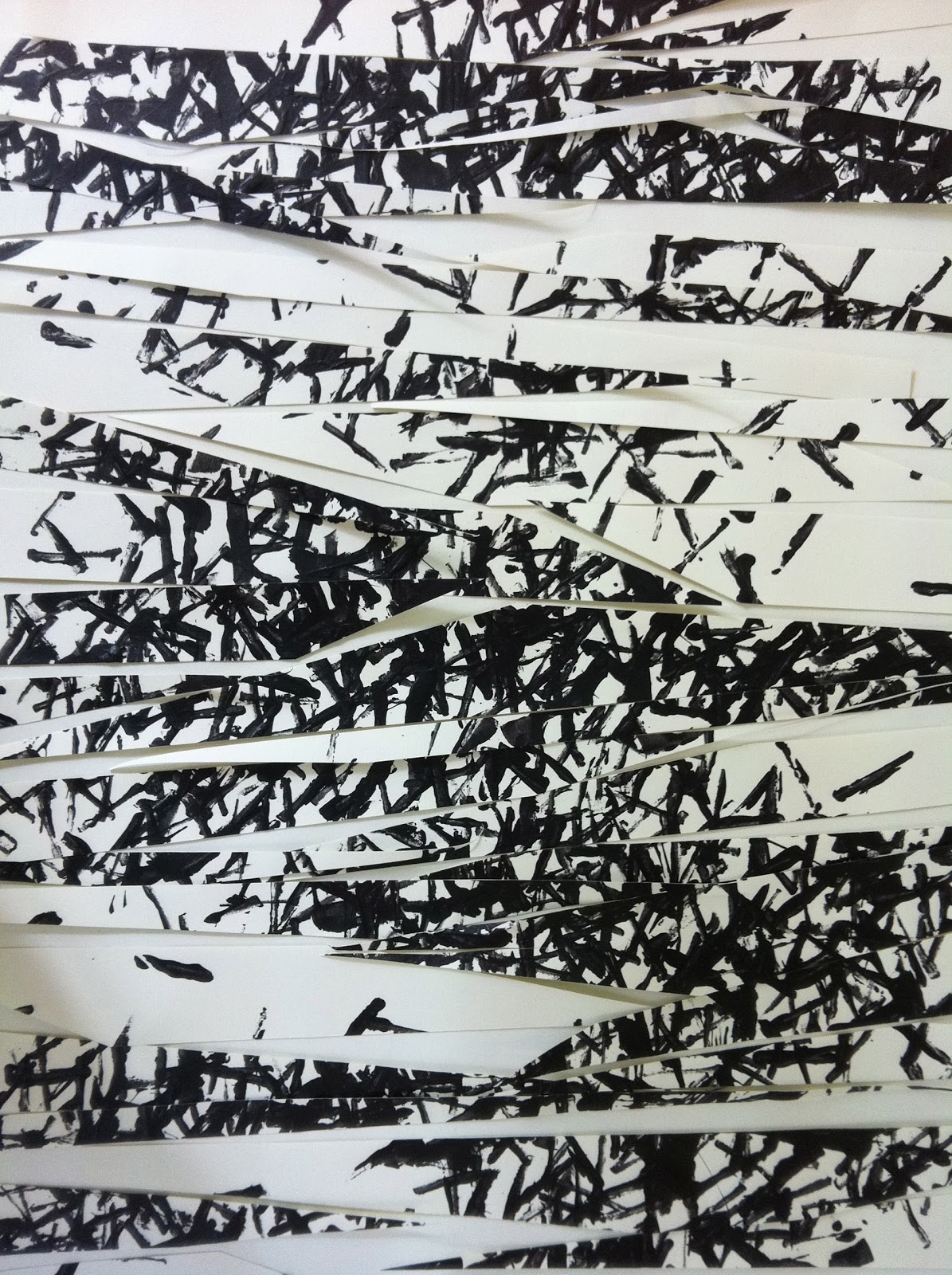
Today I tried to develop my strip paintings from last week, bt continuing to cut them up and re-order these secondary fragments, as I began to do on tuesday at college.
Firstly I cut the strips I'd made on Tuesday into yet smaller pieces, and then rearranged them into a random heap on the kitchen table...
And then into an increasingly conscious arrangement to replicate the sense of scattering/exploding which was in my very first thinking about the project theme...
I liked this result, but it didn't look so well on the table, so I repeated the whole thing onto a sheet of black paper, and i liked this better
So I painstakingly glued them down, one by one, as seen here... The complete piece is about 3 feet square.
I think I may try to do something with this via photoshop: the sense of fragmentation is heading in the right direction for the effect I have been trying to achieve, and I am also getting keen on the idea of producing some prints as part of the final piece(s). My photoshop skills are not very advanced, so this may be quite a stretch for me and there is no longer a great deal of time for wholly new things.
Firstly I cut the strips I'd made on Tuesday into yet smaller pieces, and then rearranged them into a random heap on the kitchen table...
And then into an increasingly conscious arrangement to replicate the sense of scattering/exploding which was in my very first thinking about the project theme...
I liked this result, but it didn't look so well on the table, so I repeated the whole thing onto a sheet of black paper, and i liked this better
So I painstakingly glued them down, one by one, as seen here... The complete piece is about 3 feet square.
I think I may try to do something with this via photoshop: the sense of fragmentation is heading in the right direction for the effect I have been trying to achieve, and I am also getting keen on the idea of producing some prints as part of the final piece(s). My photoshop skills are not very advanced, so this may be quite a stretch for me and there is no longer a great deal of time for wholly new things.
Thursday, 3 May 2012
Quilting inspiration
To the monthly meeting of Bristol Quilters last night, a group I joined last year but have been notably absent form meetings (largely because Wednesday nights also means Red Notes singing and I have had split loyalties). From now on Quilting will win out every fourth week.
It was an interesting presentation from Hilary Gooding, who is a member of the Contemporary Quilts group of the Quilters Guild (as am I), and she showed a wide range of quilts from her earliest 1970s Laura Ashley hexagons (we all did them...I still have several examples in a basket somewhere), through to some really very interesting small journal and abstract quilts made more recently. Her message was, essentially, try new things, try design, try drawing and observation, there are no rules.
I haven't actually done amy quilt-making for quite a while now, but I am beginning to have itchy fingers and I plan to do some serious sewing once the Foundation show is over. And the BQ group is a nice way to stay in touch, pick up a little inspiration, and share ideas with like-minded obsessives.
It was an interesting presentation from Hilary Gooding, who is a member of the Contemporary Quilts group of the Quilters Guild (as am I), and she showed a wide range of quilts from her earliest 1970s Laura Ashley hexagons (we all did them...I still have several examples in a basket somewhere), through to some really very interesting small journal and abstract quilts made more recently. Her message was, essentially, try new things, try design, try drawing and observation, there are no rules.
I haven't actually done amy quilt-making for quite a while now, but I am beginning to have itchy fingers and I plan to do some serious sewing once the Foundation show is over. And the BQ group is a nice way to stay in touch, pick up a little inspiration, and share ideas with like-minded obsessives.
Tuesday, 1 May 2012
College, 1st May
After feeling a bit deflated yesterday, I resolved to use this afternoon to try my own kind of 'cut out' method, inspired by looking last night at the work of William Burroughs. I took one of my A2 card-print pieces from yesterday,
and sliced it randomly through the big guillotine and then arranged the pieces to make a similar shaped piece.
And then I took the pieces and cut them some more, and did it again, and got a more complex arrangement.
And then I scatted them about with less care, so they overlapped and made an irregular shape.
I am not quite sure whether, or how, to take this further....but I have brought them all home and will explore further in the next few days.
Later I had another tutorial session with Abi, and showed her what I'd done with photocopying small strips of cut-out text on Sunday and she suggested we tried this on the college's bigger A3 printer/copier. Which we did, and also used some bigger pieces of shredded paper from the college office.
These are the ones with bigger strips... which I rather like, particularly the negative, with black 'ribbons' on a white background.
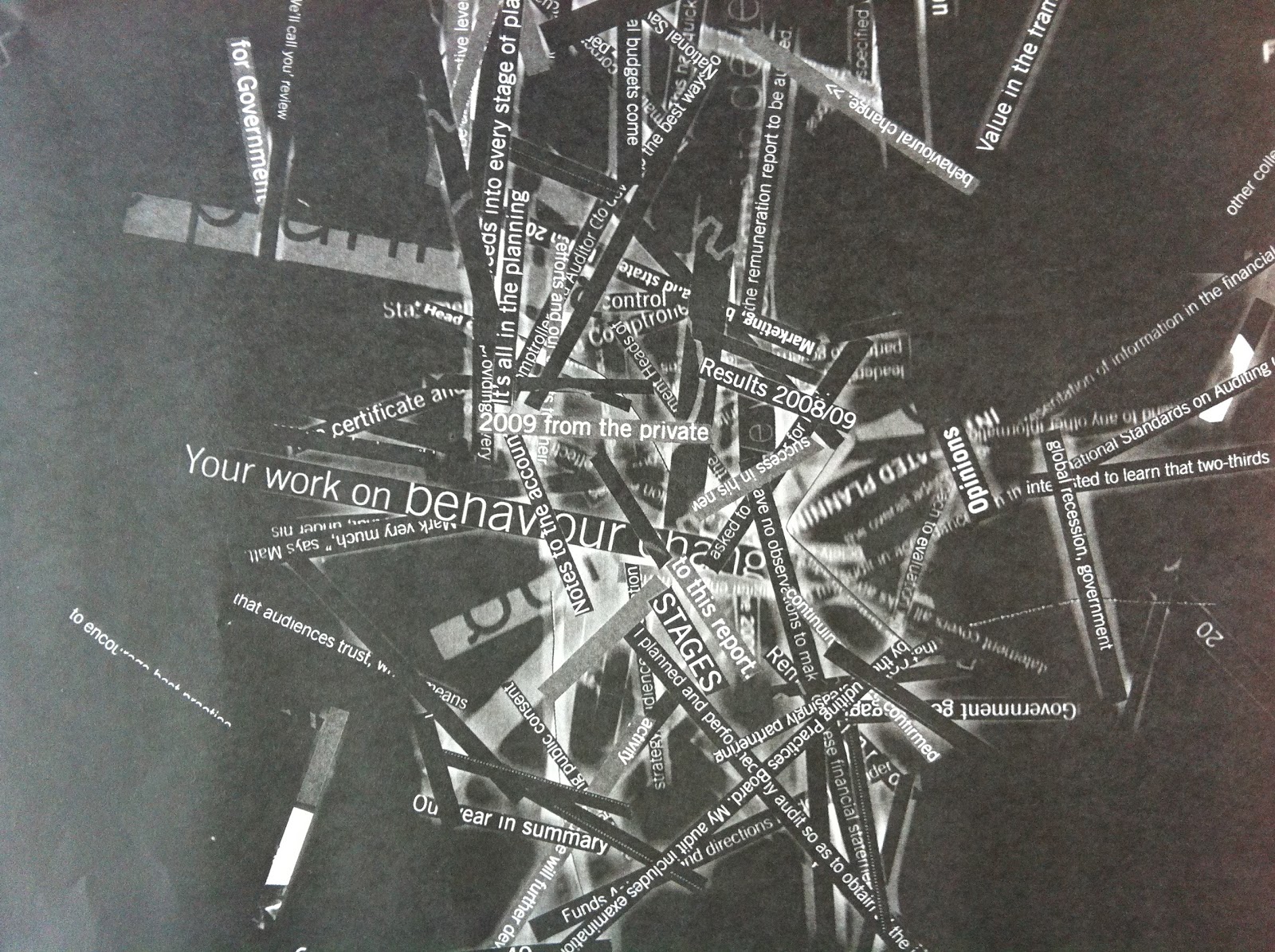
These are done using my carefully cut lines of text, the first with a background of black card placed on under the lid of the photocopier, so you still see the paper as white with black text, but you also get interesting echoes and shadows where the lid hasn't made complete contact with the screen itself.
This is an 'ordinary' photocopy, just scattering the cut-out words and phrases onto the screen.
These images, especially the ones in negative mode, highlight the negative spaces between the strips of get, and I liked those. But once again, I've made some interesting images but I can't see quite how I could use these towards a purposeful finished piece. But this exercise also, helpfully I think, took me one step still further away from the original paper. However, I am not sure how I could develop this, and I don't want to be constrained to photocopying. But perhaps there is something there still for me to draw or paint.....
and sliced it randomly through the big guillotine and then arranged the pieces to make a similar shaped piece.
And then I took the pieces and cut them some more, and did it again, and got a more complex arrangement.
And then I scatted them about with less care, so they overlapped and made an irregular shape.
I am not quite sure whether, or how, to take this further....but I have brought them all home and will explore further in the next few days.
Later I had another tutorial session with Abi, and showed her what I'd done with photocopying small strips of cut-out text on Sunday and she suggested we tried this on the college's bigger A3 printer/copier. Which we did, and also used some bigger pieces of shredded paper from the college office.
These are the ones with bigger strips... which I rather like, particularly the negative, with black 'ribbons' on a white background.
These are done using my carefully cut lines of text, the first with a background of black card placed on under the lid of the photocopier, so you still see the paper as white with black text, but you also get interesting echoes and shadows where the lid hasn't made complete contact with the screen itself.
This is an 'ordinary' photocopy, just scattering the cut-out words and phrases onto the screen.
Monday, 30 April 2012
College, 30th April: project work
I started the day by making another series of ink drawings based on a scattering of the shreds of my paper, as I had done at home. Oddly, they didn't seem to be so convincing, possibly because I was doing them on a bigger scale (A2), and possibly because I was getting rather mechanistic about it all.
This one (above) looks vaguely oriental, I did it with quite a big brush and slightly watered acrylic paint. It bears no resemblance to my paper shreds at all, even though tried to put the marks where bits of the paper had actually fallen.
The next one looked more coherent, I think, and was done with the print-from-strip-of-card technique, but using bigger card than I had previously.
This third one was also done with card-print, but used thicker card and shorter pieces, and possibly much thicker paint.
However, where is all this going? I had a helpful (if a little painful) tutorial with Mark today, who challenged the direction I've been going for the past few days, with the drawings and painting based on the scattering of paper shreds. His argument was, roughly, that while it is good that I've been getting away from the physical reality, and therefore the limitations of context, material and scale of the actual paper pieces, I'm just going down yet another dead end - the 'drawings' are not taking me anywhere useful: they may be visually interesting (although I don't think he thought so) and tactile, but what are they saying? Without some further explanation, he felt, they don't relate to my concept.
Hmmm. I can see his point. And while it has been quite fun to make these pieces, perhaps that is as far as I should go with them.
However, there is something about the method I was using in doing the first of the drawings - scattering the scraps of paper, and slowly making a marked line to replace each one. There is a method and a rhythm to this process which maybe could lead somewhere.
Mark suggested I look at Marcel Duchamp and the use of chance. Duchamp applied the use of chance to various contexts, including music (you can listen to the rather odd results here) Also to think about process and method drawing, such as Sol le Witt.
Some of the work I'd done last week included being able to see the words themselves, and yesterday I had cut a lot more bits of recognisable text. Mark referred me to have a look at William Burroughs, who worked with Brion Gysin to develop his 'cut out' model, where Burroughs would take a page of text, and cut it into four (or sometimes more) pieces, and rearrange them so you could still read a flow of text, but the phrases were broken and mixed up, and sometimes entirely new words were created from the joined-up fragments of half lines of text. There is a filmed interview and demonstration of this on You Tube here. I hadn't come across Burroughs in this context before, although I had been experimenting with other ways of rearranging, or distorting, or obscuring, or erasing the text, and thereby to remove or change or subvert its meaning. So perhaps this is another route to explore a little further.
However, time is now beginning to press rather urgently, and I need to make some firm decisions this week about what I will pursue, and what I will leave aside.
This one (above) looks vaguely oriental, I did it with quite a big brush and slightly watered acrylic paint. It bears no resemblance to my paper shreds at all, even though tried to put the marks where bits of the paper had actually fallen.
The next one looked more coherent, I think, and was done with the print-from-strip-of-card technique, but using bigger card than I had previously.
This third one was also done with card-print, but used thicker card and shorter pieces, and possibly much thicker paint.
This next one was done similar but I made a real effort to concentrate the prints in the centre, and to build up a very dense colour and rich, D texture., as visible in the close-up images below.
However, where is all this going? I had a helpful (if a little painful) tutorial with Mark today, who challenged the direction I've been going for the past few days, with the drawings and painting based on the scattering of paper shreds. His argument was, roughly, that while it is good that I've been getting away from the physical reality, and therefore the limitations of context, material and scale of the actual paper pieces, I'm just going down yet another dead end - the 'drawings' are not taking me anywhere useful: they may be visually interesting (although I don't think he thought so) and tactile, but what are they saying? Without some further explanation, he felt, they don't relate to my concept.
Hmmm. I can see his point. And while it has been quite fun to make these pieces, perhaps that is as far as I should go with them.
However, there is something about the method I was using in doing the first of the drawings - scattering the scraps of paper, and slowly making a marked line to replace each one. There is a method and a rhythm to this process which maybe could lead somewhere.
Mark suggested I look at Marcel Duchamp and the use of chance. Duchamp applied the use of chance to various contexts, including music (you can listen to the rather odd results here) Also to think about process and method drawing, such as Sol le Witt.
Some of the work I'd done last week included being able to see the words themselves, and yesterday I had cut a lot more bits of recognisable text. Mark referred me to have a look at William Burroughs, who worked with Brion Gysin to develop his 'cut out' model, where Burroughs would take a page of text, and cut it into four (or sometimes more) pieces, and rearrange them so you could still read a flow of text, but the phrases were broken and mixed up, and sometimes entirely new words were created from the joined-up fragments of half lines of text. There is a filmed interview and demonstration of this on You Tube here. I hadn't come across Burroughs in this context before, although I had been experimenting with other ways of rearranging, or distorting, or obscuring, or erasing the text, and thereby to remove or change or subvert its meaning. So perhaps this is another route to explore a little further.
However, time is now beginning to press rather urgently, and I need to make some firm decisions this week about what I will pursue, and what I will leave aside.
College, 30th April: Art History
This morning was almost the last session we will have with Jo Kear, and she gave us a quiz, drawing randomly on some of the images and artists we'd looked at over the pats year. All kinds of things came up, from the terracotta Army, to the Sistine Chapel, to Annie Liebowitz's photo of John Lennon and Yoko Ono, to the Thames Mud project. Our team of (older) part-times came second, beaten only by not knowing the exact date of the terracotta army. It was fun, and a good reminder of the huge range of things we've covered.
Sunday, 29 April 2012
More drawing and paper shreds
Among the pieces I made the other day, I rather liked the ones where you could still see glimpses of the text - especially obvious when I actually glued down, onto black paper, some of the cut up get form printed documents. They looked good in photographs, because you can see snippets of the text emerging. They didn't look so good 'in the flesh' because I had assembled it rather roughly, you can see the glue, it just looks like a jumble of sippers of paper.
However, I liked the idea of mixing up fragments of text, so today I tried cutting strips of text from the CoI documents, and then scattering them onto the bed of my printer/scanner/copier - to see what kind of image I got when concentrating on random rearrangement of the words, or fragments of text. This looked better than the glued version, but there are lots of shadows on the photocopied image, and I ma not sure how to iron these out.
The first few were done with scraps from my shredder, so the bits are very small and a bit crinkled from being squeezed through the shredder blades.
The later ones, shown below, were done with strips of text which I had cut out carefully, so you can see whole words or phrases...
I might try putting these into Photoshop and see what happens with various manipulations. I could also think about enlarging al or parts of the image. More to explore here, perhaps.
The first few were done with scraps from my shredder, so the bits are very small and a bit crinkled from being squeezed through the shredder blades.
The later ones, shown below, were done with strips of text which I had cut out carefully, so you can see whole words or phrases...
I might try putting these into Photoshop and see what happens with various manipulations. I could also think about enlarging al or parts of the image. More to explore here, perhaps.
Subscribe to:
Posts (Atom)