Showing posts with label portraits. Show all posts

Tuesday, 3 January 2012

College again already! 3rd January 2012

Only ten of us managed to make it to college for the first day of the new term today - and we had a very god session on art history with Jo Kear looking at portraits, and what makes celebrity.

This one, of Michaelangelo painted in 1504-6 while he was painting the Cistine Chapel ceiling was made by one of his apprentices, Marcello Venusti and was commissioned by the Medici family.

We looked at how the use of light and shade (chiaroscuro)  concentrates the viewer's attention purely on the face, and even then only half the face is illuminated.  The sitter seems to be looking confidently out towards the viewer, but also seems distracted, as though he will turn back to his painting in a moment.  We are told nothing about him apart from his face, no information about dress, location, etc.  It is a very concentrated portrait.

Other images we considered included this deep and meaningful portrait of Princess Diana, by Mario Testino in March 1997, 5 months before the car accident in Paris.


We all thought this was a lovely portrait of Diana, but also that it was carefully managed to project her intended new image as a single woman, no wedding ring, no fancy background, just a very nice dress.
In looking up the image, I found that it was actually a cropped down version of a slightly bigger image,  shown here...


This shows Diana a lounging in a slightly more relaxed pose.  Does this change our assessment of the picture?  I think not really, although there is slightly less simplicity in the bigger picture.  


Another dramatic portrait was this one by Martin Schoeller of Barack Obama tank in 2004, well before Obama won the Democratic nomination for the US presidency election in 2008.


I found this image very negative,  but some of us thought it was strong and carefully presented to show Obama as a powerful potential presidential candidate.  There is something strange about the focus (the ears and the neck are out of focus) and the lighting (the lack of shadows, and the reflected light source in the eyes) and also the camera position seems to exaggerate the nose.

Later I looked up more of Martin Schoeller's portraits - The Google Image search results are available here.  Seeing so many, all rather odd, portraits, put the Obama one into a better context.  He seems to have come out relatively well.  Some of the images are really strange, like this one of Paris Hilton

Or this one of Jack Nicholson


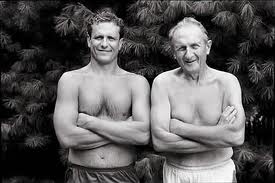
Then, rummaging through other images of portraits by Schoeller, I came across these, done for an article in the January 2012 edition of National Geographic on identical twins.  A really interesting, and less distorted, set of images of pairs of twins, showing how his 'up close and personal' portraiture can help distinguish the fine detail of differences between otherwise very similar faces.


The National Geographic photo archive link is here.


We all liked the interesting and unusual 3D construction portrait of J K Rowling, made by Stuart Pearson Wright in 2005 for the National Portrait Gallery.   The only images I could find online showed only the painting/construction, and not the surroundings which show the 'box' like room in which the images are located.  So this doesn't show quite the 3D impact of the whole.  I'm not are where Jo found the bigger image she showed us today.


 There is something almost dolls-house like about the way the portrait is mounted within a "room" depicting the simple writing requirements of Rowling in her early, unpublished years in Edinburgh, , and her still very private life.

We looked at several other images, including Sam taylor-Wood's video portrait of David Beckham sleeping, which I have seen at the NPG, and a rather unpleasant (deliberately so?) newspaper portrait of Damien Hirst in 1997.    We also looked briefly at four ancient busts of Roman Emperors - two of which looked to me just like former senior civil servant colleagues of mine...who shall be nameless.  The point of all this was to make us see what we could perceive of character from an un-named portrait, and how we ascribe attributes and personality on the basis of presentation.  Also, a brief discussion about who commissions portraits, who controls the page, how much leverage the sitter has, or not, over the pose, tone, style, etc.   All very interesting, and food for thought at future exhibitions.

Monday, 31 October 2011

College week 8/1 31st October Art History

Today's topic was 'Using People" and majored on the work of photographer Annie Leibovitz (b 1949, Connecticut, USA).  Art college trained, her work is carefully composed and thoughtful. She has worked in many spheres, including Rolling Stone magazine and lots of work with musicians, film stars and other celebrities.   Among her iconic images were some taken of Mick Jagger when she went on tour with the Rolling Stones in 1975.


 She also took a definitive photo of John Lennon, with Yoko Ono, only hours before Lennon was assassinated in New York in 1980, and which was used on the cover of the tribute edition of Rolling Stone magazine.


Some of her portraits refer back to previous painters, or to fairy tales or stories, even when the commissions are for fashion magazines or advertising.  Such as this 


She also has a body of very personal photos of her family, here her brother and father.


and here of her partner Susan Sontag.  


She famously photographed the Queen in 2006 and was filmed doing so by the BBC, who also recorded the fact that the Queen was less than happy with the photography session.  The results, though, were magnificent portraits of the queen, combining the sort of stately dignities she might have wanted, with the kind of fairy-tale mists and mystery of some of her other work.


She didn't like being the subject of photographs herself, as in this wonderful portrait by John Keatley in which she seems to be hiding from the camera, using her hand to shield her face but also mimicking the position she adopts, looking at the subject?viewer through one eye, when she is working the shutter.


More about her work in a Guardian article here:
http://www.guardian.co.uk/artanddesign/jonathanjonesblog/2007/may/02/annieleibowitzoneofthemos

Wednesday, 5 October 2011

College week 5/1 Art History

This week was called 'Telling Tales' and looked at works which relate to fairy tales, fear and fantasy, childish things which acquire an easy otherness for adults.   Not really my thing.

Jo Kear also gave us some hints on useful electronic sources of information on art, including You Tube and Twitter, and a brilliant website called Design Milk, where there are all kinds of amazing and interesting bits of art and design - such as this continuous-line drawing with a difference  The link is http://design-milk.com/faber-castell-pen-portraits/


or these amazing embroidered portraits by Cayce Zavaglia.  Check her website link here

http://design-milk.com/embroidered-portraits-by-cayce-zavaglia/#more-82970


Also I was intrigued by the foldable cover of the current issue of the German design magazine Novum - I am going to try to get hold of a copy.  Looks amazing...


There is a video about how the cover was made, follow the link here  to novum  is here
http://design-milk.com/novum-magazines-foldable-paper-cover/#more-85681

Tuesday, 20 September 2011

College Week 3/1 Art History

Monday mornings now start at 9.30 with Jo Kear's Art History lectures.  Today we were looking at portraits, how to 'read' them, and what they tell us about the artist and the sitter.  We looked at a wide range of types of portrait,  commissioned for differing purposes.  Holbein's portraits of Anne of Cleeves


 and Christina of Denmark in 1538,


were commissioned by Henry VIII when he was scanning the courts of Europe for his fourth wife.

Eugene Delacroix's self portrait in 1828 - confident, direct, colourful - was compared with his friends and cousin Leon Reisener's Daguerrotype portrait of him 14 years later - less direct, darker, more anonymous somehow.  

We looked at Vermeer's Girl with the Pearl earring, and considered why and how some portraits lose touch with the identity of the sitters.  


Jo introduced us to a National Museums and Galleries of Wales portrait of Kathryn of Berain, whose history is somewhat mysterious.  Note - to flag this up with Jo and with Wales Women's Archive for a possible presentation at a future annual conference.  


The National Portrait Gallery has commissioned a series of imagined lives of some of the unknown people in some of their paintings, with an exhibition at Montecute House in Somerset.  The link is here.  It might be worth a visit together with a trip to textile and print shows at galleries in Somerton and Wells.....

Co-incidentally, I picked up a flyer at the RWA today for a new dramatic series being put on in the Alma  Tavern this autumn, where writers have been invited to create short plays based on the characters shown in a series of old photos culled from a market stall in Berlin.  More info is here.