Showing posts with label final project. Show all posts

Wednesday, 27 June 2012

Taking it all back home


Today was packing up day, last day in college, and results day.  All rather sad, but also joyful.

It is interesting how much quicker it is to take something down, than to put it up!  College was stripped bare by 10.30, while it had taken days to get it all cleaned and tidy and hung.  Hmm. 

Here is my pile of things, looking rather forlorn, and ready for a taxi home.


I decided to bring all the cut strips home.  I think they still have life in them, and if all else fails, I can turn them into paper mache bowls.....


Oh, and we got our results, and I was delighted and not a little stunned to get a Distinction!

Doing Foundation has been an absolutely brilliant thing, has transformed the way I think about art, myself, things in general. has given me new skills and awareness, some new friends, and a new direction.  I am so grateful to the college and the tutorial team for leading us through it all, and for being such great people. 

So now for a long summer, keeping myself busy (there is lots to be done) and trying to focus a little on print-making and what I want to get out of the MA course at UWE.  And doing as much as I can of drawing, mark-making, printing, photography, looking at art, and thinking.  And perhaps, even, remembering how to use my sewing machine and doing a bit of much-neglected quilting too.

Tuesday, 26 June 2012

Final Show

The Final Show at Queens Road previewed on Friday night, and then ran until Tuesday, with a rota of students taking turns to steward it.

The opening night was a great success - but ridiculously crowded.  Over 100 students were finishing, and the college space is tiny, so it was quite a squeeze with parents and children and friends all winding round the corridors trying to see all the work.

I thought the standard was generally pretty high, and it was good to see the finished work of so many of the full time students, who we have had very little to do with most of the time.  Here are some images of some of the work I particularly liked, but I fear I did not always securely attach names to images, so some are unattributed.


I really liked several of the painters' work, but especially this one by Georgia Smith.

This was an amazing construction of a garden shed, complete with a full complement of bits and pieces.


These face casts were cleverly located half-way down the stairs to the ceramics studio.  


This was by Maeve Anne, who is going on to do an MA in Dublin, and is about the way we perceive meaning in relation to images.  It was huge, about 4 ft in diameter. 


This complex map of Easton, a Bristol neighbourhood, was by Jo Knight, and represented the women in this culturally and ethnically diverse area, and recorded the places they had come from. Jo did a series of taped and transcribed interviews with the women too.


This is part of a group of pieces by James Norman, called The Departed, which was about the loss of lives in the First World War.  This piece is a relief, rather than a painting, and includes a muddied and battered pair of soldiers' long-johns, and a lot of hatred fruit, and ash, and quite a lot of mud and pva as well as paint.  James also had a small excavation in the college back yard, and a very moving continuous sound accompaniment, of his reading, in dead-pan tones, a random selection of lines from Wilfred Owen's wars poetry.  It sounds chaotic when described like this, but in reality was both moving and visually (and aurally) exciting.  James is going on to do a BA in Fine Art at UWE 

And finally there was my box of bits of paper.  I attached a note to the box, in the hope that people would play with the scraps: 

deconstructing 
a life in words and paper
shredded, scattered and strewn
feel free to touch, delve, build, search find
de-constructing is also re-constructing


It seemed to work - people did investigate, and lift and dig and sculpt with the paper., so I achieved a result in terms of getting people to engage with the feel of the paper, and perhaps to think about how we throw things (including ideas) away, and how ephemeral our work can be.


 People also seemed intrigued by the tiny snatches of meaning on the scraps of paper strip - and they lifted them up to read and wonder about the words, and to search of other interesting snippets.  Someone said it was a bit like getting Fortune Cookies at a Chinese restaurant.  Or a Christmas lucky dip.  
Overall, I was quite pleased with how the show went, and how my pieces fitted in to the whole.  My film was on the show reel with 7 others, os it was quite a challenge for people to sit and watch the whole lot.  But whenever I went in to the film room, people generally were sticking with it, even though there was no punch line.  I didn't hear any negative comments so I guess that was as much as i could hope for.  I rather liked the film, anyway.


Monday, 18 June 2012

Exhibition preparation

Monday was the day for us to bring in all our work and our final pieces for assessment and for the exhibition which will open on Friday.  It was a rather nice day - college was all clean and tidy with fresh white paint on every wall, and there were lots of students fidgeting with their final pieces, fixing things to walls, arranging things on plinths and shelves, doing last minute adjustments, and setting out research files, sketchbooks and  development work for the assessors.  There was plenty of time to look at other people's work, before what will hopefully be a very crowded Private View on Friday evening.

My installation was fine, I was grateful for some help from James in assembling the open box onto the square plinth, and then I filled it up with my paper.  It looked like this....

I thought this was OK - except there didn't seem to be quite enough of the paper.  I wanted to create a rich sensation of being able to delve into the heap, and it was, frankly, a bit thin.  So I rushed home at lunchtime and furiously sliced up a bundle more women's history magazines and journals from way back, and a few other things including at least one of my essays.  When I could face using the guillotine no longer, I rushed back to college and added all this new material to the heap.  And it was considerably better for being much fuller. Like this..... 


It is now possible to pile up the strips and create little landscapes and sculptures, which is what I wanted to achieve.

I had to do another title for my film on the show reel, too, but I was pleased with the ways the film looks on the bigger screen.  The noise of the emergency siren, coming in the middle of the film, still seems to be OK, even though it obscures the sound of the paper falling for a while.  Anyway, it is all done now, and I just hope it comes out OK in the assessment - and I also hope that the box and plinth will be ok in the bustle of the Private View.  They are just a little vulnerable to being knocked into or knocked over in the place I've been allotted - but I mentioned this to several of the tutors and hopefully it will be moved, at lead a little, before the doors open on Friday.


Saturday, 16 June 2012

Finished at last!

I have spent the best part of the last few days doing all the last bits and pieces for my Foundation Diploma assessment and the final show.  Our work has to be delivered to college on Monday for assessment and the final show opens on Friday evening.

I thought I had more or less got everything done, but there was still a lot - including the bibliography and project evaluation.

Well, at last it is all done, and all packed up in boxes and folders ready to take in on Monday.  And here it all is.....


And I am feeling quite cheerful about the work itself, and the way it has all come together. My two complementary final pieces can't be shown here, although I will have some photos later on, once the show is done.  

I am submitting a short film I made at college which is  of thousands of little strips of cut-up paper falling into a big heap on the floor, complete with sound.  

And secondly an installation consisting of a big flat open wooden box, 3' square and sitting on a pedestal about 3' high, which will be filled with those same strips.  Visitors will be invited to delve into the heap with their hands, to pick up the strips and drop them again, to listen to the sounds they make, to pile them up into weird and wonderful shapes and sculptures, and generally to experience the exhilaration of letting go of an old life full of words and papers and essays and report writing, in exchange for a new freedom to create and experience textures, sounds, sights and shapes. 

Well, that's what I hope will happen.  I have a private nightmare that the plinth will get knocked over and the paper scraps will be spread across the floor....  I am a little worried about the location I've been given within the exhibition rooms, and may need to negotiate about this when I take everything in on Monday.

I am so pleased to have it finished!  But what on earth will I fill my time with now?  One urgent task is to give the house a much-needed clean and tidy.  The kitchen has been totally invaded for weeks, and somehow things have found their way into every corner of the house.  

So, given the continuing rain and wind, what better way to spend Saturday afternoon than having a good old tidy? Actually I can think of a great many nicer things to do, but needs must....

And the second thing to do, which is definitely nicer, is to make the Ginger and Rhubarb loaf which my lovely daughter Charlie has just up-loaded onto her blog charliemakescakes.blogspot.co.uk and which sounds scrumptious.    

Monday, 28 May 2012

More filming

Today I had another go at filming my paper strips, having seen how the first efforts came out and having a (slightly) better idea of what kid of images I wanted to create.  I rigged up a kind of stage set in the painting studio with sheets of black card on the floor and making a wall behind, of sheets of card fixed to the edge of a long strong table, which I could stand on to scatter the paper strips.  With assistance from James, who kept a watchful eye on the camera settings and angle, I let the strips fall from about 5ft high, onto the black floor.  They scattered beautifully (it was a slightly higher drop than previously, and a slightly bigger floor area too).  

The resulting film is about 3.41 minutes long, which is about right, and has sharp sound of the paper falling - it sounds a bit like rain.  In fact, the sound is almost too sharp - it was a very hot day and windows were open os there is a slight roar of traffic throughout, enhanced by an emergency siren at one point: I don't know how to deal with this so will accept it and leave it in, as added context.   The angle of the camera is such that the 'horizon', i.e. the edge between the horizontal floor and the vertical backdrop, is almost exactly in the centre of the film, and this enhances the impact of the growing heap of paper, white against the black background.

Here is a still of the paper pile at the end of filming.

I was pleased with the result and I think it will stand well as it is, without any need for editing or further work.  Just a title, which Wesley says he is going to do, constant in style, for all the films to go on the show reel.  


Monday, 21 May 2012

College, 21st May

Things are hotting up at college, towards the final assessment and end-of-year show next month.  We only have one more Monday studio session after today.... and there is still a lot to do.

This morning started with a group tutorial with Mark, mainly about writing our evaluations, and preparing for the show.  After that, we were free to work on our projects.  I had booked a video camera and tripod to film my paper scraps, and I had brought in a large box full of scraps, plus some black cloth as a backdrop. 

After a quick tutorial from Wesley about how to use the video camera, I wandered the college searching for a quiet place in which to film.  The only place seemed to be the cubby-hole where people can store portfolios, a tiny broom-cupboard of a room, with very little floor-space but with a door which closed.

I set about rigging up black cloth and sheets of thick black paper to make a backdrop and to block out the racks of portfolios, and then squeezed the tripod into a corner, with the box of strips balanced on a cupboard.  

Off I went - switching the camera on to run on its own, and scattering strips from above.  The trouble with this was that, because of the tiny space, I couldn't actually see into the monitor of the camera, and had no idea how the film was coming through.  When I paused, to zoom in and then out, I still couldn't really see if the angle was any good.  


When I finished, and had a look, it seemed to me that the lines of sight were very short and constrained (they really were!) and although the film had worked on the most basic of levels, it was hardly going to make good piece.  Rather dispirited, I gathered up all the paper scraps, undid the black screens, and trailed back to the print room to reconsider.  I was close to giving it up as a bad idea.

But then I realised that, during the lunch hour, other rooms were empty and quiet, and also more pscaious.  I went into 04, the painting room, and it was empty of people.  I found a bit of floor-space and covered it with black card.  I found Maeve-Ann, who had been saying, earlier, that she was not terribly busy, and asked if she would give me a hand, which she did very willingly.  With Maeve-Ann operating the camera, I could concentrate on dropping the scraps.  We shot one film, just of the scraps falling, and then we gathered them all up and shot another 5 minutes, this time with me in the shot, dropping the paper pieces.  This looked much better, and the pile of scraps grew wonderfully on the studio floor.  Since I had cut more over the weekend, I hadn't seen the size of the full pile before... and it is now BIG!


Then Maeve-Ann set the camera running again without telling me, and so we had a third, quite long, piece of film showing me playing with the scraps, rather like playing with sand on a beach, and she and I talking about what they mean, as we gathered them up and put them back in the box a second time.  The heap was so big, it was possible to dig right into it and make mountains and sharp jagged sculptures out of them.  Some of them reminded me of the images of the twin towers after 9/11, when the jagged pieces of the buildings stood out against the sky.  Some just reminded me of playing with sand-castles with children, letting the strips fall through your fingers, and watching the shifting shapes of he mound as they moved.   It was great fun to do, and surprisingly tactile.  Actually, the whole business of dropping the pieces was extremely satisfying, and cathartic.  It really did feel as I'd intended, as though I was letting go of years of academic study.  It might have felt better still if I'd been able to use real work papers, but in the end it hadn't proved possible to get hold of those kind of papers.  And over the decades I have sweated quite enough blood over academia too.  


By the end of half an hour or so, I had really quite a decent amount of film - and I'm very grateful to Maeve-Ann for her help as it was very tricky to get the angles right and I would have been struggling to do all this on my own, and it was also very good to discuss it with her as we worked.

Later I saw Wesley who helped me down-load the film from the camera, and showed me the briefest outline of how to edit it using i-movie.  So tomorrow I will see if I can take the best bits of these films and transfer them into a single run which would be fit for showing on the show-reel in the final exhibition.  If need be, Wesley has offered to help me get this right.  Also Mary, who has done some film editing during her A-level course. So I will be well-blessed with advice on this...and I'm sure I'll need it as I'm still struggling to get onto the same intuitive wavelength and the Mac designers.  

I also had a useful tutorial with Mark this afternoon about my plans for the final show, and the idea of having a kind of 'sand box' on a plinth in which the strips will be placed, and people encouraged to handle them.  I then saw Jan in the workshop and have left him a drawing and instructions about materials, dimensions, etc, and he says he will make this for me for next week.   I had thought I'd like the box about 3' x 2'6"... but on the way home I thought perhaps a square would be much better, to allow the pieces to fall in a circular mound, and so tomorrow I will alter this to ask for a 3' square box.

I finished the day feeling I had made real progress and cemented my plans for the final show - which fortuitously also require very little by way of further preparations, once the film is edited.  Which means I can concentrate now on tidying up my sketchbook, organising my research file, filling the gaps in this blog, and also preparing my portfolio for the UWE interview on 12th June.


Tuesday, 15 May 2012

College, 15th May

This afternoon I decided to do a proper reflection and review of my project so far, because I feel as though I have been getting stuck, not making progress, flitting from one idea to another, and not getting on even with the essentials, e.g. updating my note/sketch/ideas book, or finishing my research folder.  Luckily, most people were busy and so the main print room was almost empty and quiet, so I could settle down and read through everything, starting with my original Statement of Intent.  It proved to be a very therapeutic process, as it reminded me of the strong ideas I had started out with, and allowed me to see (a) how much exploratory work I have done, which seems to me to be quite a lot, and quite wide-ranging; and (b) to see that I have been on a rather circuitous journey, but that I have now almost arrived at a place which makes sense for the final presentation of my project.  I came away at the end of the day feeling a lot happier, and with a (long) list of things i now need to do to finish off the background.research/ideas work, and to complete the pieces for the final show.

There will be two pieces.  One will be a properly made film of the paper shreds falling.  I've booked a video camera and tripod for Monday, and will bring all the paper shreds into college and find a quiet place to do the filming here on Monday.  That should leave plenty of time on Tuesday to edit the film, and it can go on the group 'show reel' which will be prepared and run continuously during the show.

Secondly I'm going to organise a big flat tray-shaped plinth, ideally about a metre square but it will probably have to be a bit smaller than that.  It will have an upright 'wall' all round it, about 5 or 6 inches high.  Inside I will line with black paper and/or paint it matt black.  I will pile up all the shreds of paper inside the box.  The idea will be to invite visitors to touch the paper, to pick it up and door it, run their hands through it, like sand in a sand-pit.

I may, if time allows, also make a small book to go alongside the paper box, to link the box and the film with the concept of deconstruction,  throwing away, creating new.

I am trying to hang on to the principle of "less is more" but my piece is so conceptual I'm a bit worried that it may be too obscure.  But it depends how well the film comes out...and/or whether the pieces in a big aback box work either.  I might end up with just one or the other but not both.  NO harm in having options, even at this late stage.....

Monday, 14 May 2012

College, 14th May


We had a very useful, if scary, session first thing, for the whole cohort, full- and part-timers, about preparing for the end of year show next month.  We have to make definite proposals for exhibition space/walls/plinths/film/whatever next Monday, so this was very helpful preparation, and lots of advice on why not to do, what works, what doesn't, giving ourselves enough time to hang properly, etc, etc.  This was followed up by workshop time, which I hadn't prepared for very well, so I ended up doing some late library work, checking references for my research file and bibliography, and so on.  I did, though, have a useful tutorial with matt, and firmed up y ideas for making some kind of short film of my paper shreds falling.  I did a try quick test piece yesterday, holding my i-phone camera in one hand, and gently dropping the paper shreds with the other. It worked in terms of showing that the images could be made to work, and - most of all - the sound was good.  I had put big sheets of black paper onto the kitchen floor, and the sound of paper falling on to paper was strong - when the flow of paper built up, the sound was rather like heavy rain, or running water.


Friday, 4 May 2012

4th May: more scattered strips

Today I tried to develop my strip paintings from last week, bt continuing to cut them up and re-order these secondary fragments, as I began to do on tuesday at college.

Firstly I cut the strips I'd made on Tuesday into yet smaller pieces, and then rearranged them into a random heap on the kitchen table...


 And then into an increasingly conscious arrangement to replicate the sense of scattering/exploding which was in my very first thinking about the project theme...


I liked this result, but it didn't look so well on the table, so I repeated the whole thing onto a sheet of black paper, and i liked this better

So I painstakingly glued them down, one by one, as seen here...  The complete piece is about 3 feet square.


I think I may try to do something with this via photoshop: the sense of fragmentation is heading in the right direction for the effect I have been trying to achieve, and I am also getting keen on the idea of producing some prints as part of the final piece(s).   My photoshop skills are not very advanced, so this may be quite a stretch for me and there is no longer a great deal of time for wholly new things.


Tuesday, 1 May 2012

College, 1st May

After feeling a bit deflated yesterday, I resolved to use this afternoon to try my own kind of 'cut out' method, inspired by looking last night at the work of William Burroughs.  I took one of my A2 card-print pieces from yesterday,


and sliced it randomly through the big guillotine and then arranged the pieces to make a similar shaped piece.


And then I took the pieces and cut them some more, and did it again, and got a more complex arrangement.


And then I scatted them about with less care, so they overlapped and made an irregular shape.


I am not quite sure whether, or how, to take this further....but I have brought them all home and will explore further in the next few days.

Later I had another tutorial session with Abi,  and showed her what I'd done with photocopying small strips of cut-out text on Sunday and she suggested we tried this on the college's bigger A3 printer/copier.  Which we did, and also used some bigger pieces of shredded paper from the college office.

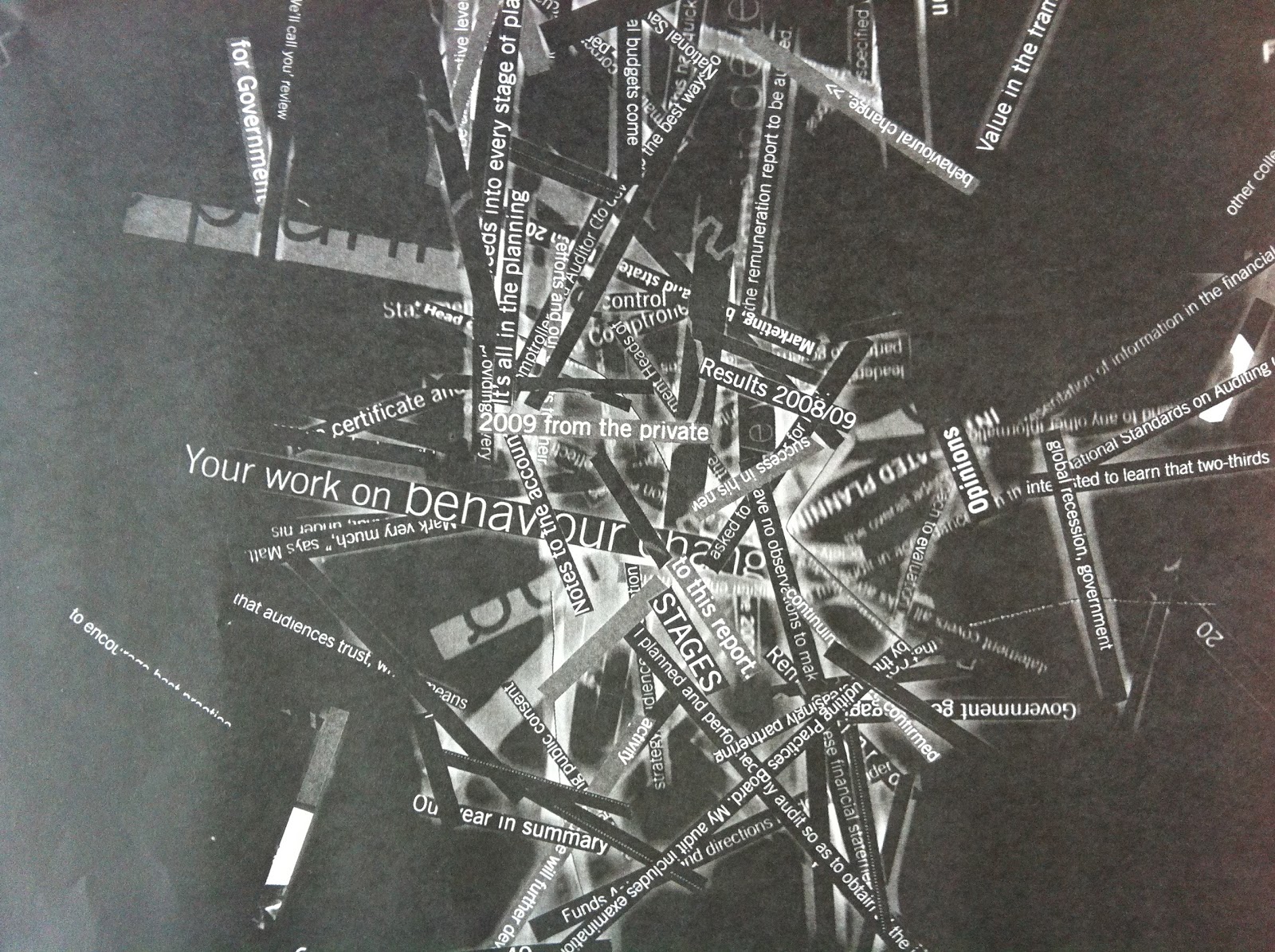
These are the ones with bigger strips... which I rather like, particularly the negative, with black 'ribbons' on a white background.


These are done using my carefully cut lines of text, the first with a background of black card placed on under the lid of the photocopier, so you still see the paper as white with black text, but you also get interesting echoes and shadows where the lid hasn't made complete contact with the screen itself.


This is an 'ordinary' photocopy, just scattering the cut-out words and phrases onto the screen.


These images, especially the ones in negative mode, highlight the negative spaces between the strips of get, and I liked those.  But once again, I've made some interesting images but I can't see quite how I could use these towards a purposeful finished piece.  But this exercise also, helpfully I think, took me one step still further away from the original paper.  However, I am not sure how I could develop this, and I don't want to be constrained to photocopying.  But perhaps there is something there still for me to draw or paint.....

Monday, 30 April 2012

College, 30th April: project work

I started the day by making another series of ink drawings based on a scattering of the shreds of my paper, as I had done at home.  Oddly, they didn't seem to be so convincing, possibly because I was doing them on a bigger scale (A2), and possibly because I was getting rather mechanistic about it all.


This one (above) looks vaguely oriental, I did it with quite a big brush and slightly watered acrylic paint.  It bears no resemblance to my paper shreds at all, even though tried to put the marks where bits of the paper had actually fallen.


The next one looked more coherent, I think, and was done with the print-from-strip-of-card technique, but using bigger card than I had previously.


This third one was also done with card-print, but used thicker card and shorter pieces, and possibly much thicker paint.


This next one was done similar but I made a real effort to concentrate the prints in the centre, and to build up a very dense colour and rich, D texture., as visible in the close-up images below.


However, where is all this going?   I had a helpful (if a little painful) tutorial with Mark today, who challenged the direction I've been going for the past few days, with the drawings and painting based on the scattering of paper shreds.   His argument was, roughly, that while it is good that I've been getting away from the physical reality, and therefore the limitations of context, material and scale of the actual paper pieces,  I'm just going down yet another dead end - the 'drawings' are not taking me anywhere useful: they may be visually interesting (although I don't think he thought so) and tactile, but what are they saying?  Without some further explanation, he felt, they don't relate to my concept.


Hmmm.  I can see his point.  And while it has been quite fun to make these pieces, perhaps that is as far as I should go with them.

However, there is something about the method I was using in doing the first of the drawings - scattering the scraps of paper, and slowly making a marked line to replace each one.  There is a method and a rhythm to this process which maybe could lead somewhere.

Mark suggested I look at Marcel Duchamp and the use of chance.  Duchamp applied the use of chance to various contexts, including music (you can listen to the rather odd results here) Also to think about process and method drawing,  such as Sol le Witt.

Some of the work I'd done last week included being able to see the words themselves, and yesterday I had cut a lot more bits of recognisable text.  Mark referred me to have a look at William Burroughs, who worked with Brion Gysin to develop his 'cut out' model, where Burroughs would take a page of text, and cut it into four (or sometimes more) pieces, and rearrange them so you could still read a flow of text, but the phrases were broken and mixed up, and sometimes entirely new words were created from the joined-up fragments of half lines of text.  There is a filmed interview and demonstration of this on You Tube here.  I hadn't come across Burroughs in this context before, although I had been experimenting with other ways of rearranging, or distorting, or obscuring, or erasing the text, and thereby to remove or change or subvert its meaning.   So perhaps this is another route to explore a little further.

However, time is now beginning to press rather urgently, and I need to make some firm decisions this week about what I will pursue, and what I will leave aside.

Wednesday, 25 April 2012

Final Project - new directions

Inspired by my last tutorial with met, I spent much of today playing around with shreds of paper, trying out some of the ideas which emerged on monday.

I tried various ways of stitching paper strips onto long threads - using both white cotton thread, and invisible nylon, and trying this out on some printed paper strips, and some strips torn from my hand-made paper.  Neither is easy to do.

Nylon thread is incredibly difficult to handle, and hard on the eye-sight too.   Here I have used nylon thread on hand-made paper.


This is cotton thread on hand-made paper but I was left with a double threads from the machine stitching.


The white cotton shows up more, but is considerably easier to work with.

This is cotton thread on a printed paper strip, but I cut the bobbin thread between each strip, so that there is only one thread visible.  This works better and if I continue with threading, I will use this method - it looks site good and is easier to handle than the invisible nylon.

 I don't have anywhere at home to hang long threads from, so I only made about half a dozen pieces at this stage.  I liked the way the shreds of paper twirled around once they are hanging, and a fair number of these, grouped together, would make  quite a strong visual impact.  but it might drive me insane making them.

I also tried throwing shredded paper onto a large sheet of black paper, and then drawing lines where the paper fell.


 I used various media - different pale-coloured pencils and then a gold pen.  I rather liked the mysterious quality of the lines themselves, and also the way, on black paper, the patterns of lines doesn't stand out, but is interesting when you get close.


I then covered a sheet of black paper with a thin layer of pva glue, and dropped the cut strips of text on to that - so I have a sort of collage of the trips...which worked quite well although the glue shows up rather too much.

.. and here in close-up.  I like the loose texture, the strips are not glued completely or firmly to the backing, but tumble over each other, preserving the sense of free-fall they had when they were scattered.


I tried a similar approach, this time dropping the small strips of printed paper on to a white paper base, and then drew the resulting marks with a black marker pen.  i liked the strength of the lines I got from this.


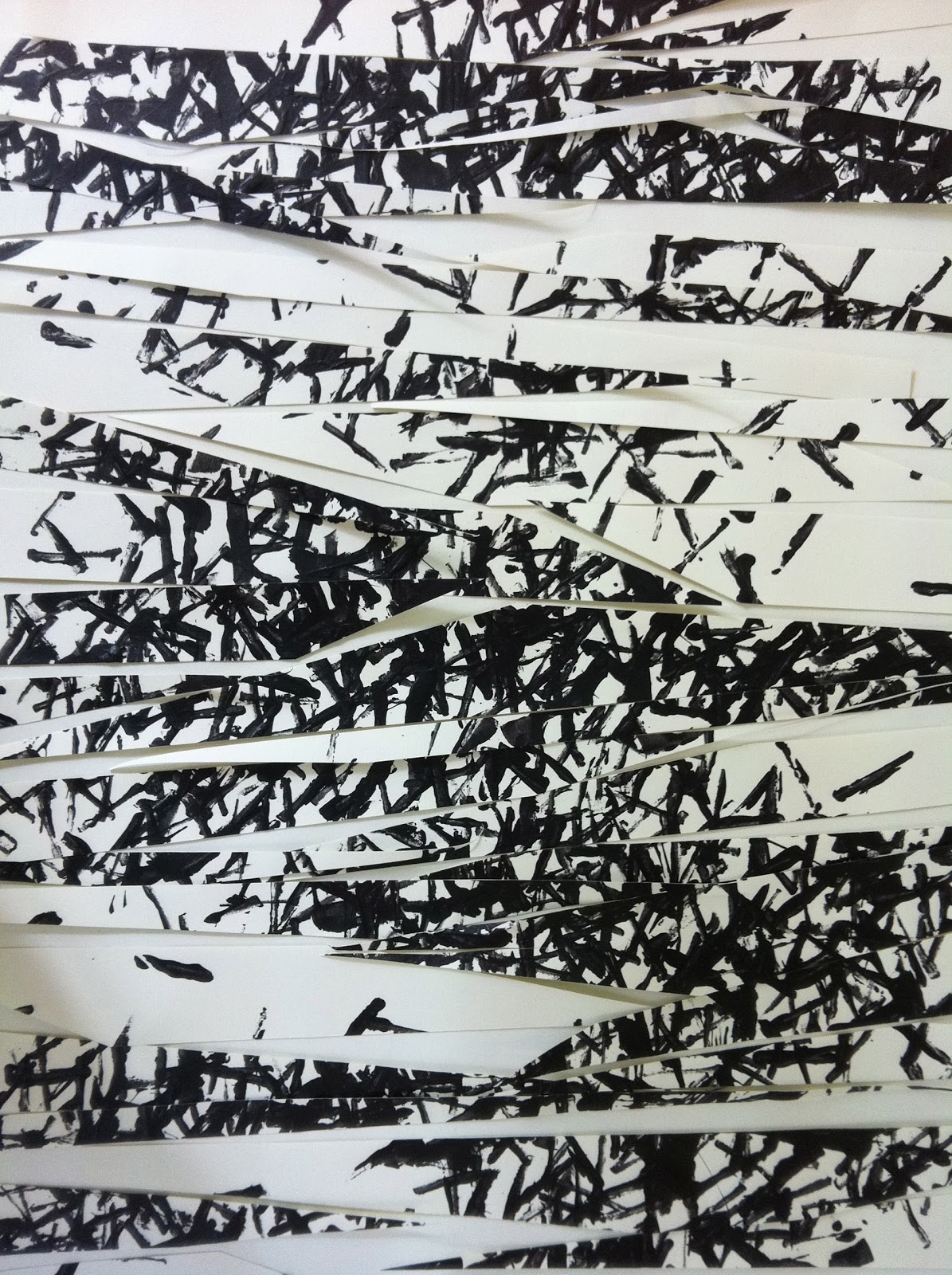
Next I abandoned using the actual paper strips, but instead I used slightly diluted black acrylic paint, and a strip of card dipped into the paint and used as a small printing device, to create a pattern of higgledy-piggledy overlapping short lines, but with a concentrations in the middle, to represent the heap of paper shreds.  I like the overall effect of this approach, and because the acrylic paint was quite thickly applied, there is a 3D texture to the finished image.

This is the image half completed,  with a relatively thin scattering of lines...


...and the same in close-up...


and even closer...


This is the finished version, with much denser drawing of lines...


In close-up you can see the rich texture of the paint...


and even richer here...


And then I repeated this approach using Indian ink and smaller strips of cardboard.  This also worked well.


I am pleased with these results - partly because I just liked the results, but mainly because this has taken me into a new dimension with the project itself.  It is still rooted in the torn or shredded strips of my 'old life' papers, but translates these into a different context - of drawing, and printing, and creating an image which is embedded in the concept but is separate from it and which has a visual identity, and an abstraction,  all of its own.

I did all three 'drop' drawings on a single long sheet of paper (wallpaper lining paper, strong, cheap and infinitely accessible) draped along my big kitchen table.  I rather liked the way the three related but different images work together.  This image doesn't do them justice, because they were still lying horizontally.  But hung vertically, I think they would look very good.  I might want to use this as a back-drop for my final show piece....


The marks I have been making today seem to me to be related to the mark-making I did in my second Pathway Project too - although that was 'non-writing' there was a similarly abstract quality about them, a rhythm which I seem to have got again today, and also the use of monochrome black and white, which I think emphasises the strength and interest of the liens themselves.

I think this is worth pursuing further, and tomorrow I will explore how else I could capture this idea in stitch and in other types of simple print.